Sunday, 15 February 2015

As Early as 2016, Robot Cops Will Be Patrolling Your Streets…….No, Seriously


real-life-robocop-to-patrol-the-streets
By 2016, there will likely be a 6-foot tall police robot patrolling the streets and handing out parking tickets. The Telebot, developed by Florida International University’s Discovery Lab, has been field-tested and is undergoing final tune up.
With a swiveling head and dexterous fingers, the humanoid robot is controlled remotely by a person wearing an Oculus Rift headset and motion-tracking vest, arm bands, and gloves. The voice of the remote operator is transmitted through the robot to the unfortunate citizen on the receiving end.
The menacing look of Telebot is no accident. Its design is one “…that can intimidate and display a sense of authority.”
Justification for this (let’s just say it) Robocop, is couched in appeals to sympathy, to help disabled officers and veterans “get back on the job.” The reality is that it introduces another level of intimidation to the increasingly militarized police state and brings us one step closer to a dystopian future where autonomous robots carry out law enforcement.
As robots become more agile, we may see an increase of an armed robotic police presence.
But even when companies can meet all the technological demands of an autonomous, armed police force, there’ll still be social and political hurdles. What happens if a police robot malfunctions and harms someone, for example?” – How Police Robots Work
If a human police officer can get away with killing so easily, as The Free Thought Project continually documents, what would this mean for the robot officer?
A fully autonomous robot officer is already in the works. The Knightscope K5 does not wield weapons but serves as a total surveillance machine for cops or private clients. It has facial recognition and scans 1,500 license plates per minute, captures audio and 360-degree video, tests the air for chemicals, and maps its surroundings with 3D radar and laser. It can learn to distinguish “suspicious activities” from normal activities.
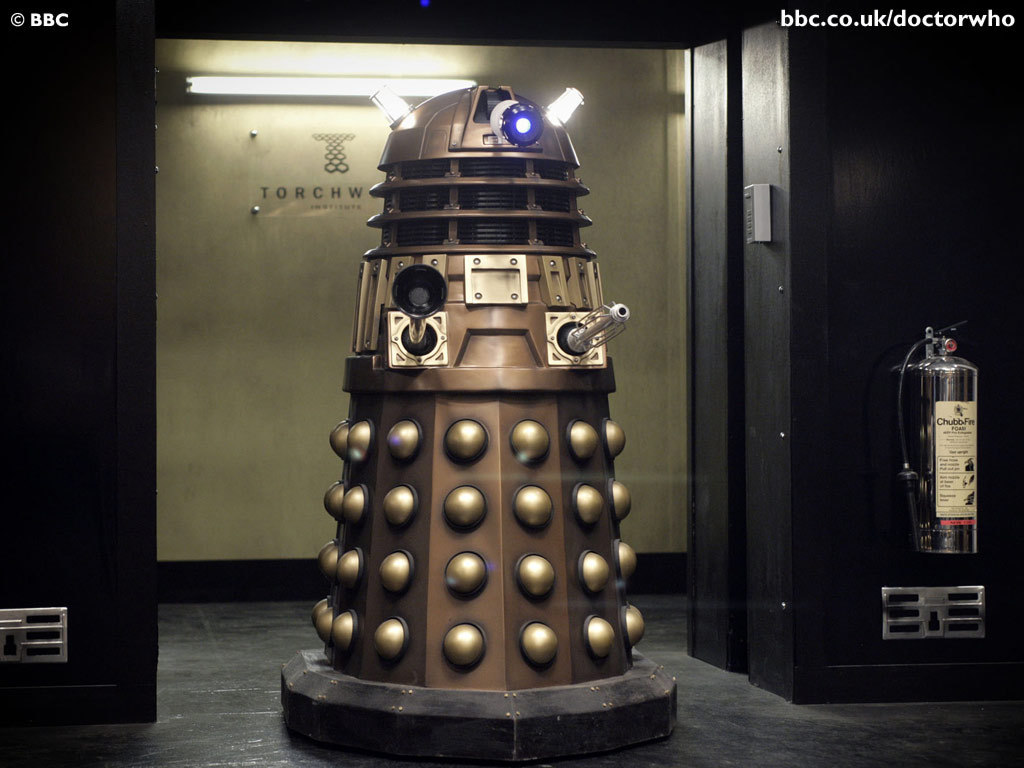
When the K5 puts all this data together and detects what it perceives as trouble, it alerts local authorities. In a few years, this Dalek-like robot will be recording people’s actions and conversations in public places all over.
Robots have been used for years to detonate or disable bombs. Nothing controversial there. But police robots are increasingly being developed for use against people. Large remote-controlled robots are now fitted with arms that can breach doors or hold live weapons.
In a display of just how badly things can go, in 2011 a police robot burned down a mobile home after triple-warhead gas grenades were fired into the home instead of flameless grenades.
The danger from police robots is not only ground-based. The Skunk Riot Control Copter is designed to “control unruly crowds” by firing up to 20 paintball or pepper spray rounds per minute from each of its four barrels. It also features strobe lights and lasers to dazzle the would-be protester, and, of course, the full range of surveillance capability to monitor the crowds.
The militarization and robotization of police state USA is related to a Department of Defense (DoD) program starting in 1997 that transfers excess military equipment to police departments, to help them fight the immoral war on drugs. DoD has already given police more than $5.1 billion worth of military equipment.
The Department of Homeland Security is part of the game too, giving grants to police departments for advanced tactical hardware to help fight those freedom-hating terrorists. Only, the government now treats its own citizens as terrorists. Peaceful protesters fill the lenses and microphones and crosshairs of robot police.
In these troubling times, we can turn to satire for some relief. The Onion sums it up nicely: New Law Enforcement Robot Can Wield Excessive Force Of 5 Human Officers
Unfortunately for the citizens of Police State USA, this is no laughing matter.

SHARE THIS ARTICLE...

SOURCE: THE FREE THOUGHT PROJECT

Saturday, 14 February 2015

The FDA Is Hiding Scientific Fraud, And You Should Be Pissed


The U.S. Food and Drug Administration – the agency tasked with protecting public health via regulation of everything from food safety to prescription drugs – occasionally encounters serious instances of misconduct in biomedical research. According to an investigation published in the latest issue of the Journal of the American Medical Association, these cases include
...falsification or submission of false information... problems with adverse events reporting... protocol violations... inadequate or inaccurate recordkeeping... failure to protect the safety of patients and/or issues with oversight or informed consent... [among other violations]
Study author Charles Seife, an acclaimed science writer and professor of journalism at NYU, writes that "the FDA has no systematic method of communicating these findings to the scientific community, leaving open the possibility that research misconduct detected by a government agency goes unremarked in the peer-reviewed literature." In the course of his investigation, he identified fifty seven published clinical trials for which an FDA inspection of the trial site had turned up "significant evidence" for at least of the aforementioned problems.
The problem with these problems is that they are not reported. At least, not in any meaningful way. "The FDA has no systematic method of communicating these findings to the scientific community," writes Seife, "leaving open the possibility that research misconduct detected by a government agency goes unremarked in the peer-reviewed literature." By failing to make this information readily available, the FDA compromises the ability of scientists, doctors, and the public – that means you – to remain informed about scientific trials fraught with misconduct.

READ MORE...

SHARE THIS ARTICLE...

14 Things I Wish Everyone Knew About Love

field
Love is something I have occupied myself with since my early teenage years, exploring bonds and relationships both in a practical and theoretical sense. Having mostly had healthy and long-lasting relationships has allowed me to better understand what makes a relationship good, and what pieces of less-than-satisfactory relationships can act as general red flags.
I figure people who really want to read a text written as pose will have already read my What Is Real Love article, so this will serve as a more compact and slightly divergent extension of that text. It will also carry over a few points from my text about respect, because healthy and real love will always encompass respect. But that’s enough intro: onto the pointers!
1. Love is not about possession or dominance, but instead about understanding, appreciation, and giving.
Love has nothing to do with imposing rights or expectations onto others. It has everything to do with appreciation and giving. No one owns another, and there are clear reasons that most of the world has abolished slavery. This is especially true in a romantic connection. A healthy relationship or connection cannot be based on confusing intimacy and ownership.
2. Love is not a passive feeling, not something you fall into, but something you stand up into.
As Eric Fromm so elegantly puts it in his “Art Of Loving”, love is not something one “falls” into but instead something one “stands up” into. Before you are prepared to take responsibility for your half of a connection and to acknowledge and appreciate what comes back, you will not be able to experience real love. The romanticized “falling” is based more on hormones than a multi-level love as we are discussing it here, and a successful relationship is based on a lot more than hormones.
3. Love entails going beyond your own walls and opening yourself up to new perspectives and experience.
Love isn’t about just doing things you already like and are comfortable with, but it is instead about having the security to venture beyond your walls. Appreciation and joy are drawn out of not just identifying and understanding someone or something else, but exercising these positive feelings in new contexts.
4. Love is not stable, and it requires energy and understanding to maintain.
No one has a good day every single day. Expecting this of yourself, or of others, is a guaranteed path to disappointment. Love is not a constant upward movement on a time-happiness graph, but instead simply a mode of increasing the average joy derived from every moment. There will be hard days, but they become easier when we know how to divide the load one carries on their shoulders, so to speak.
5. Love is about openness, not secrets.
Love is about sharing, and feeling safe enough to do so. Love is about letting others share, and understanding them even if we still need to speak criticism. Being able to voice criticism, and hear it from others, is as important as being able to share or hear positive things.
6. Love is a tool for spiritual evolution. A romantic connection is, metaphorically, very similar to a double-helix.
In the same way nature selects for things that don’t work, our ability to love allows us to better understand ourselves, others, and the connection between ourselves and others. A good relationship is like a double-helix, stabilized both by the (hydrogen) bonds between the bases and the backbone, with stronger bonds giving higher resistance to increasing temperature.
If your relationship is not helping you extend yourself and grow, then you need to either examine the bonds or your own backbone, so to speak. In the same way a helix turns, roles and positions within a relationship should be free to develop and change dynamically.
7. Most “love” you see in pop culture (Hollywood etc) is not healthy, nor is it remotely connected to real life love.
Building your understanding and expectations for love should not be obtained via pop culture. If no one has told you yet, there are quite a few emotionally unhealthy people who write both our movies and our music. Although romantic gestures are important, and sex is great too, that is not the entirety of love.
8. Trust and understanding are the first steps in experiencing real love.
Trust is not just something you can have in another person, but also in yourself and your actions. One requires an astounding amount of trust to create a unique and creative romantic gesture and give it to someone else: you have to trust both yourself to create something worthwhile and trust the other person to understand and accept your gesture. Trust is based on experience, and you cannot expect a wild romantic gesture to be understood by someone who doesn’t or hardly know(s) you. How can you love the world, the trees, and the birds, if you don’t trust them to exist as they are?
9. Love is not just an activity, it is a skill.
Being able to understand, experience, and share love are skills. They aren’t things people are born understanding. Many people who were not presented with functional models of these activities as a kid have a harder time understanding and expressing them as adults. Whether you are a veteran lover or someone with little experience beyond one-night-stands: we all have room for growth and improvement.
10. Love is more complex than any bullet-point list can capture completely.
Don’t rely on anyone, not even me, to tell you everything you need to know about love. Since we all have different experience with the different parts of love, our growth and improvement is unique. Although these are the points I think are most generally misunderstood, do not hesitate to go far beyond. Trust yourself to discover parts and dimensions of love that others have forgotten to mention.
11. Love doesn’t have to be connected with, or involve, sex.
This seems like a no-brainer, but I feel like it should be mentioned. Love can be expressed romantically with sex or sexuality, but love itself is not necessary connected to sexuality. The love of a parent and the love of a romantic partner share many parallels and both are referred to as love, but only the latter involved sexuality.
12. Love doesn’t require reciprocation: you don’t need to get back what you give.
To love something or someone does not require that they return or mirror this love. Although most of us are aware that it would likely be misled to expect a crow or spider to love you in the same way you love or care about it, many forget that this truism extends its veracity into relationships with people. This is clear to any parent that has ever had their kid express hatred for them, but maintained their love and support of the child. A lack of reciprocation is not an affront or insult, but part of the give-and-take nature of life, and the fact that our trust is not always well invested.
13. Love is multi-dimension, and we subjectively decide where we emphasize value.
Whether you are most thrilled by the abstract thoughts, caring nature, responsible demeanor, wild confidence, or whatever else, this is a personal thing. We all want, and need, different things. What we want is, ironically, not always what we actually need. It is insanely narcissistic to disrespect the individual preferences of another: love is experiences slightly differently by each of us.
14. You don’t need a special person in your life to experience love: you only need your mind.
Love is something we hold up and experience for ourselves. Feelings of love we have others has more to do with what we construct in our minds than it has to do with them. This is why we can never get mad at others for disappointing us in dimensions we never discussed, or for failing to conform to our view of them: this is as true for dealing with people as it is for dealing with nature. Love is something we carry inside of us, and we should not attribute it to others… if others mirror our feelings then we can rejoice, but that is in itself not a condition of love.


 Things I Wish Everyone Knew About LOVE

Anonymous are about to wage war on rich and powerful covering up child sex abuse in ‘nightmarish’ Friday 13th protest

Masked protesters will march on the homes of “elite” paedophiles and public figures they claim have been involved in the “nightmarish” cover-up of child sex abuse.
In a video released on YouTube, Anonymous says it has exposed a club of people in positions of trust and responsibility that have been murdering and torturing children.
“Friday the 13th will see us become the nightmare on Elite Street,” the message says.
#OpDeathEaters Why do we fight for the voiceless, defenseless victims of #Pedosadism you ask? We ask, why don't YOU? Join us in protesting!
— OpDeathEatersTX (@OpDeathEatersTX) February 13, 2015
“Politicians, royals, media, religious figures, singers, actors, men and women; it seems that the long grotesque arm of this club has no bounds

Full article here 

SHARE THIS ARTICLE...

Friday, 13 February 2015

Rand Paul: What If Companies Could Create Their Own Currencies?

"Because I’m sort of a believer in currency having value," Paul said in a separate interview, "if you’re going to create a currency, have it backed up by—you know, Hayek used to talk about a basket of commodities? You could have a basket of stocks, and have some exchangeability, because it’s hard for people like me who are a bit tangible. But you could have an average of stocks. I’m wondering if that’s the next permutation."
Today, at another Lincoln Labs event—this one quartered at the Chamber of Commerce offices in Washington, and titled "Reboot Congress," TechCrunch founder Michael Arrington asked Paul to expand on his view of Bitcoin.
“I'm sort of an outlier on the Bitcoin thing.”
Senator Rand Paul
"You've said it was 'pretty cool,'" said Arrington.
"That was my scientific analysis," said Paul.
"My only question there is, post-apocalypse, are you gonna be a gold guy or a Bitcoin guy?" asked Arrington.
"I'm sort of an outlier on the Bitcoin thing," said Paul. "I've been fascinated by the concept of it, but I never would have purchased it myself. I'm just a little bit skeptical. I remember reading an article by Marc Andreessen—obviously, I respect him, he's a smart guy, and he's made more money than I have. He wrote about Bitcoin, and the thing that fascinated me about what he wrote was that, if you imagine something like Wal-Mart, that's got a 4 percent profit margin, and they're laying 2 or 3 points to Mastercards, that there are ways to eliminate the credit card company through Bitcoin."
Paul was referring to a few arguments that Andreessen, whose Bitcoin views verge on utopian, had been making since 2013.

READ MORE...

SHARE THIS ARTICLE...

Guess Who Peddled 7-Year Old Photos of a Different Country As If They Show a Current Russian Invasion of Ukraine?

How Blatant Can the Propaganda Get?
Senator Inhofe was duped into presenting photographs that were up to 7 years old – some of which were taken within the nations of Georgia, Ossetia and Russia – as showing a current Russian invasion into Ukraine.
Who misled the good Senator?
Take a wild guess:
“The Ukrainian parliament members who gave us these photos in print form as if it came directly from a camera really did themselves a disservice. We felt confident to release these photos because the images match the reporting of what is going on in the region. I was furious to learn one of the photos provided now appears to be falsified from an AP photo taken in 2008.”
How blatant can the propaganda get?

SHARE THIS ARTICLE...

Thursday, 12 February 2015

SAUDI ARABIA ‘ENGINEERED’ OIL CRISIS: DALLAS FED CHIEF

“We are a huge supplier of energy. The Saudis took a while to realize what was going on,” Fisher said, referring to the massive growth of the U.S. oil industry in recent years.

Fisher is the most prominent U.S. official to pin the blame largely on Saudi Arabia.

As recently as July, oil traded at over $100 a barrel. By January, it had plunged below $50.

Saudi officials have repeatedly blamed supply and demand for the price meltdown. They say they were caught off guard by the price decline, and acknowledge this is putting a lot of pressure on U.S. shale.

“Although Saudi Arabia and OPEC countries did not engineer the reduction in the price of oil, there’s a positive side effect, whereby at a certain price, we will see how many shale oil production companies run out of business,” Prince Alwaleed bin Talal, a member of the Saudi royal family and prominent global investor, said in January.

The oil games: While the price of oil started falling at the end of the summer, it was exacerbated on Thanksgiving Day when OPEC, led by Saudi Arabia, voted not to scale back on production. That send oil prices diving.
oil feb 11

Fisher also noted that the Saudis benefit not just economically, but politically from the oil price decline. Low oil prices especially hurt their biggest regional rival: Iran.

“I’m sure King Abdullah thought to himself, ‘I’ve also done a favor vis-a-vis Iran,'” Fisher told reporters. Iran’s economy needs oil to trade around $135. Saudi has far larger cash reserves and is thus able to withstand a downturn in prices for much longer.

READ MORE...

SHARE THIS ARTICLE...